Astrology and Anthroposophy

29 May 2007

Zodiac Signs and Constellations


The chart on the left was cast for 1:40 pm today in Dingle. You can click on image to enlarge it. I am happy that the astrology program that I use, Solar Fire, is able to produce a chart with both signs and constellations. The outer ring shows zodiac constellations and the inner ring shows zodiac signs.

Every time I make a presentation on the stars the question of signs and constellations comes up. There is the impression on the part of the more scientifically minded people that only the constellations are real. They posit that since, in our time, the Sun rises in the constellation of Pisces at the spring equinox, the claim- that the Sun goes into Aries at that time- is untrue. I would like to suggest that both viewpoints are true, just the perspective is different.

Zodiac Constellations are twelve unequal segments along the ecliptic (apparent path of the Sun as viewed from the earth.) The dividing points between the constellations were decided by a scientific convention in the early 1930’s. Once a year, at the spring equinox, the Sun returns to the same point on the ecliptic, but not quite; after 72 years, an average human lifespan, the Sun slips back about 10 in relation to the constellations of the zodiac. This is known as the precession of the equinox. The average size of one constellation is 300 and therefore it would take about 2,160 years (72x30) before the spring Sun rises in the next constellation back. In ancient India the Sun rose in Cancer at the spring equinox, ancient Persia in Gemini, ancient Egypt in Taurus, Greco/Roman times in Aries and now it occurs in Pisces. The amount of time that the Sun takes to traverse all 12 constellations is called a platonic year (2,160x12= 25,920 years)

Zodiac Signs are twelve equal divisions of the stars along the ecliptic or apparent path of the Sun as viewed from the earth. The signs come about through the relationship of the earth and Sun. As you know, the seasons are brought about by the tilt of the earth’s axis and the rotation of the earth around the Sun. For those of us located north of the equator, summer solstice comes about when the northern hemisphere is tilted towards the Sun and the winter solstice when it is tilted away from the Sun. The spring and autumn equinox both occur half way between these two points. One could say that the zodiac signs exist in time rather than in space. The first sign, Aries begins at the spring equinox followed by Taurus and Gemini. Cancer begins at the summer solstice and then you have Leo and Virgo. At the autumnal equinox Libra begins followed by Scorpio and Sagittarius. At the winter solstice Capricorn begins followed by Aquarius and Pisces. Then we are back to spring and to Aries.

Most Western astrologers work with the zodiac signs and in India, where astrology is widely practiced, they use the zodiac constellations. The latter approach is becoming more popular in the West and is known as Vedic Astrology. Anthroposophically extended astrology takes both signs and constellations into consideration. In general you could say that the signs in a birth chart have to do with this life, with the here and now whereas the constellations have to do with the life before birth (the other world.) Another way to express this in anthroposophic terms would be to say that the signs have to do more with the physical and etheric bodies and the constellations with the more spiritual parts, the astral body and the ego (I.)

Technorati tags:

19 May 2007

Esoteric Astrology

There is very little information on anthroposophically extended astrology in the English language. However, in German, there is a vast body of knowledge; even on my own bookshelf there are 40 books on the subject. This therefore is a first attempt on my part to make some of this information available to those who have not yet mastered the German language.

There is a little book by Dr. Heinz Herbert Schoeffler Gibt Es Eine Anthroposophische Astrologie? (Is There Such a Thing As Anthroposophical Astrology?) The book has just 47 pages but is packed with information about his topic. Schoeffler points out that, in his early works, Steiner intimated that astrology would not be understood until the long distant future. However, this view changed over his lifetime. In January, 1914 he spoke of how the astrology of the third post-atlantean epoch (Egyptian/Babylonian times) was coming up again and that we would need to study it, taking into consideration the Christ event that occurred in the meantime. Subsequently Steiner wove man’s relationship with the stars into almost every aspect of his work, agriculture, medicine, eurythmy, education, special needs education and so on.

Towards the end of his life, in 1924, Steiner spoke about specific birth charts for the first time in public. This was in the lecture series Education for Special Needs:Curative Education Course. At that time he also formulated the relationship between the various bodies of the human being and the planets as follows:

Spirit Man--------------Neptune

Life Spirit---------------Uranus

Spirit Self --------------Saturn

Consciousness Soul----Jupiter

Intellectual Soul--------Mars

Sentient Soul-----------Venus

Sentient Body----------Mercury

Etheric Body------------Moon

Physical Body-----------Sun

A description of the various bodies mentioned above can be found in Steiner's book Theosophy.

Schoeffler goes on to show how Steiner, over time, touched on just about every consideration of astrology:planets, the ascendant, mid-heaven, zodiac signs and
constellations,
beneficial and hindering aspects, the whole of Thema Mundi in all its details; but he never spoke of the twelve houses. Schoeffler gives a historical perspective of the houses and then proceeds to draw out of Steiner’s works a description of them. He concludes with the following descriptions:

House Astrology Anthroposophy
1 Own personality Time of birth, physical body, own personality
2 Earnings through own abilities Etheric body, above/below
3 Education, small journeys, siblings Astral body, thinking/feeling/willing
4 House, home, heredity Individuality (ego), opposition, essence of being
5 Children, art, lovers Encounter, threefolding
6 Work, troubles, small animals, acute illnesses Above and below, stars and the earth
7 Personality of partners Reincarnation, warmth, time. Stepping over the threshold.
8 Chronic illness, dying, death, acquisition through marriage. Dying, death, culmination
9 Science, books, publishing, large journeys, in-laws Rising up to the starry world
10 Deeds, profession, position, power, victory. The human being at the highest periphery
11 Friends, social gatherings, house of luck Sojourn in cosmic heights and beginning descent
12 Enemies, prisons, hospitals, physical illness, large animals. Adversity in confinement

In case you are not familiar with Thema mundi: Firmicus Maternus an astrologer and a christian from the fourth century wrote of the Thema Mundi. It is a 'birth chart' for the world with each planet in the 15th degree of the sign that it rules. The origin of Thema mundi goes back to a much earlier time.

Steiner spoke also of the planetary rulerships on 8 January 1918 in the lecture cycle Ancient Myths:" Every constellation of the Zodiac is related to a particular planet and must be regarded as belonging to that planet".


Dr. Heinz Herbert Schoeffler (1921-2003) was born in Leipzig, Germany. He was a medical doctor specializing in pedriatrics and anthroposophically extended medicine. He lectured on anthroposophical medicine and on astrology and wrote several books on these subjects in addition to the one referred to above. He saw it as one of his life’s tasks to reconcile astrology and anthroposophy.


22 February 2007

Mercury Retrograde

Mercury Retrograde (14 February to 8 March)

Viewed from the earth, all of the planets move around the zodiac in the same direction and following more or less the same pathway as the Sun. This pathway is known as the ecliptic. Strangely enough the apparent path of the Moon also follows this pattern. The planets Mercury and Venus move through the zodiac signs with the Sun, sometimes a little in front of it and sometimes a little behind it.

Sometimes the planets appear to move in the opposite direction to the Sun for a while and then they resume their forward movement. At the beginning of February, Mercury in the sign of Pisces was running ahead of the Sun which was in Aquarius. It was then visible as an evening star. On 14 February it came to a stand-still at about 15 degrees ahead of the Sun and began a retrograde movement. On 23 February Mercury will have moved back level with the Sun to a position known as inferior conjunction and will not be visible being too close to the Sun. A few days later it will appear as a morning star. It will continue to move backwards until 8 March when it will come to a stop again at about 22 degrees behind the Sun. Mercury will then have moved back into Aquarius and the Sun will have moved forward to Pisces. Mercury will then resume its forward movement once again and will disappear from view when it makes a superior conjunction with the Sun.

When Mercury is retrograde it is often hard to get new things started and travel arrangements can get confused or delayed. Communication, especially of a technical nature, often gets fouled up. Technical devices such as computers or telephone equipment are more likely to break down during Mercury retrograde. It is however a very good time to do things that begin with “re” such as revise, repair, renew and relax.

In her book Anthroposophy and Astrology, Elisabeth Vreede writes as follows: “In terms of the horoscope, the essential relationship of the inner planets to the Sun must be considered. The position of Mercury and of Venus in relationship to the Sun-whether a conjunction of elongation, whether as morning star or as evening star-determines a soul’s national and family feelings.” And further “For Mercury and Venus, the constellations in which they are situated are not as important as for the outer planets. The greater or lesser distance they have from the Sun in the birth horoscope essentially reflects the experience the soul had in passing through the spheres in question (before birth).”

Astrological literature does not usually deal with the issue of Mercury as morning or as evening star but I did find an interesting article on the web by Michael R. Meyer called The Four Faces of Mercury. He describes four types in relation to the birth chart: Mercury as evening star-retrograde, Mercury as evening star-direct, Mercury as morning star-direct and Mercury as morning star-retrograde.


23 April 2006

Astrology & Science

It is not unusual to hear someone ask if I really believe in astrology. It is interesting to note that astrology has been relegated to the domain of belief, of faith. In contrast it is assumed nowadays that science is known and factual. However, since a very small percentage of people actually do research or experiments, for most people, science and scientific findings are actually part of a belief system. Science has become a kind of religion and a very dogmatic one at that. People who question the dogma are quickly and often aggressively disposed of. This is especially true today of medicine and also of the starry heavens. What ever happened to keeping an open mind and the free exchange of ideas?


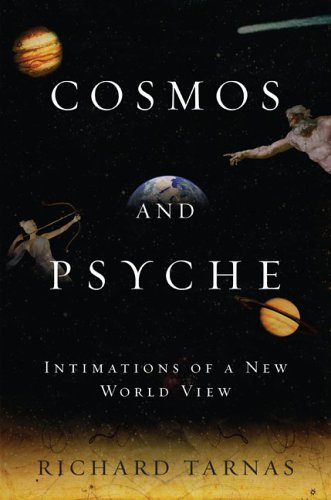
A new book has just been published that suggests that it is time to reconsider the prevailing views on astrology--Cosmos and Psyche by Richard Tarnas. Tarnas takes a broad historical perspective in his approach. He draws on the ideas of Carl Jung regarding synchronicity and archetypes. He suggests that astrological patterns are not concretely predictive but rather archetypally predictive.

The book reports on extensive research done by Tarnas on the changing position of the planets in relation to each other and he relates specific relationships to major events in history. An example is the connection of the planets Uranus and Pluto at the time of the French Revolution and during the 1960’s.

He quotes Johannes Kepler as having said in relation to astrological aspects: Experience, more than anything else, gives credibility to the effectiveness of aspects. This is so clear that it can be denied only by those who themselves have not tried them.


Technorati tags:

25 March 2006

More on Birth Chart Archetypes

Continuing with some ideas from Cosmic Aspects of Birth and Death by Gunther Wachsmuth:
The position of the planet Saturn is particularly important for science and philosophy in a person's birth chart, as is Jupiter for statesmanship and Mars for art. It is interesting to view this in relation to the four archetypes: Equalizing, Duality, Harmonizing and Polarizing that equate to the position of the Sun in spring, summer, autumn and winter respectively (see previous post on Birth Chart Archetypes for more on this.) We will take a look at three well-known Irish statesmen.

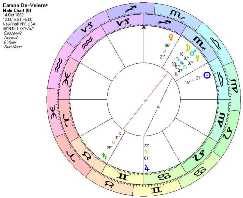
Eamon De Valera

Eamon De Valera's chart shows a people-person with four planets in Harmonizing but the planet Jupiter is in the Duality segment. This indicates that as a statesman his views would have tended towards the categorical and divisive-black and white with little or no grey areas.


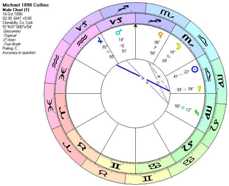
Michael Collins

I had always thought of Michael Collins as the soldier and De Valera as the politician. Collins' birth chart however shows that he had good people skills with four planets in the Harmonizing segment. Saturn in the same area also shows a people philosophy. Jupiter on the opposite side in Equalizing would suggest that he had some ideas that he wanted to bring to manifestation in the world. Mars and Venus in Polarization would indicate some passion and polarity on a creative and personal level.

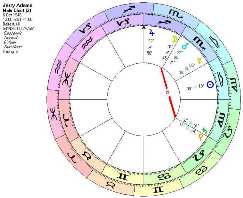
Gerry Adams

The chart of the Sinn Fein leader Gerry Adams shows very good people skills with five planets in the Harmonizing segment and his philosophy, as indicated by the planet Saturn, is in the same segment. However, as a statesman he continually finds himself in a polarized circumstance and this is indicated by the planet Jupiter. Even the Wikipedia article on the above link to his name has the following notice: The nutrality of this article is disputed.

Technorati Tags:

10 March 2006

A Vision - The Phases of the Moon

I have been working on the book A Vision about the phases of the moon by W.B.Yeats and his wife George. It describes 28 phases of the moon—one for each day of the moon cycle.

George was a member of the Golden Dawn. She was also an anthroposophist or a Steiner theosophist as they were called in those days. Four days after their wedding, George started to do automatic writing. It is said that she first did this to convince WB that, after so many years mooning over Maude Gonne, he did the right thing in marrying her. She was surprised however when, as she put herself into a kind of trance state, her pen took on a life of its own. Over a period of time, she worked on this together with her husband, he would pose questions and she would act as a kind of medium to provide the answers. Later she was able to answer the questions verbally rather than in writing. The result was an elaborate system involving the phases of the moon.

The premise is that an individuality progresses through the moon phases from one incarnation to the next. It is unclear though how Yeats calculated a person’s moon phase. One would assume that the phase would be determined by the moment of birth. This however does not work for several examples in the book. His examples for Phase 25 includes AE but if you look at AE's birth chart it shows him to be a Phase 6 and Martin Luther also shown as a Phase 25 was born at Phase 11. It is hard to believe that the Yeats would be mistaken about this but it is also hard to imagine how else to calculate the phase. I would be grateful for any comments on this.

I am preparing a database of well-known people showing the Moon Phase based on the birth chart. I don’t have enough data yet but there does seem to be a pattern. People with early moon phases seem to have certain freshness, people struggle at Phase 8 and by full-moon seem to really know how to function in the world. There is a struggle again at Phase 22 and a tendency to turn inward towards the final phases.

There is an extensive website on the subject put up by an advanced English studies professor in England.

There is an excellent poem called The Phases of the Moon that leads into the section on the The Great Wheel.

Technorati Tags:

Site Meter